Gemini 3.0, AI Overviews & Nano Banana Pro: Marketing Impact
December 10 2025
Estimated reading time: 12 minutes
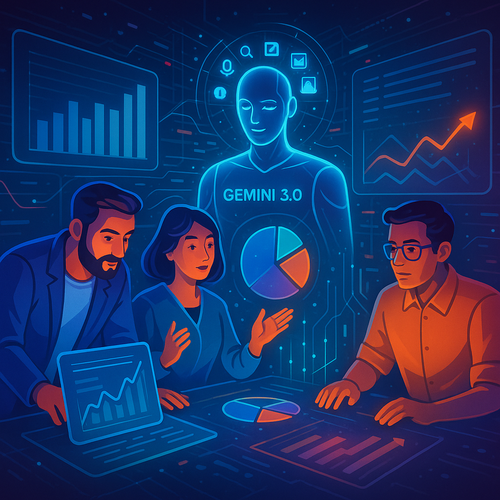
Gemini 3.0 redefines analysis, planning, and marketing task automation through its advanced reasoning, multimodal, and agentic capabilities.
Nano Banana Pro elevates AI imaging from an ideation tool to a true professional visual production engine (4K, readable text, advanced editing).
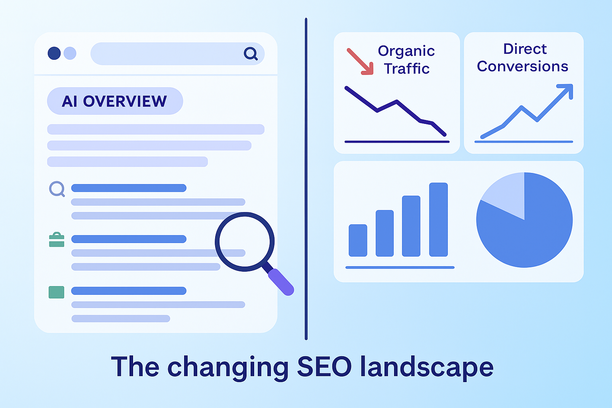
AI Overviews reshuffles attribution: measured organic traffic may drop while conversions and revenue from “direct” sources increase.
GA4 becomes your paid data command center with automatic cost imports from Meta, TikTok, Pinterest, and Snap Ads—provided you have solid UTM governance.
Kuma Agents automates campaign monitoring as part of a broader approach where AI enhances marketing productivity and decision quality.
Gemini 3.0, Nano Banana Pro, and AI Overviews: What’s the Impact on Your Digital Marketing?
In 2025, Google is accelerating the pace once again. With the launch of Gemini 3.0 and Nano Banana Pro, the search engine no longer just answers queries—it reasons, manipulates complex data, and generates complete experiences, from text to visual interfaces. Meanwhile, AI Overviews is reshaping SEO by changing how users discover and visit websites.
For marketing teams, the challenge is twofold. On one hand, you need to understand what these new tools can do to leverage them for content production, creativity, and campaign optimization. On the other, it’s becoming essential to rethink how you measure performance—particularly conversion attribution and SEO’s role in an environment where many interactions now flow through generative AI.
In this article, we break down the concrete impacts of Gemini 3.0, Nano Banana Pro, and AI Overviews on your digital marketing.
The Revolutionary Capabilities of Gemini 3.0
Google presents Gemini 3.0 as a new generation of multimodal model, capable of understanding and interacting simultaneously with text, images, audio, video, and code. Technically, it’s no longer just a language model—it’s a general-purpose AI assistant geared toward action and reasoning.
Several capabilities are particularly relevant for marketing and are transforming how teams work.
State-of-the-art reasoning on complex questions
Benchmarks published by Google show that Gemini 3.0 achieves PhD-level scores on advanced science exams and complex reasoning tasks. Where previous versions excelled mainly at text generation, Gemini 3.0 stands out in everything requiring structure and planning: market analysis, advanced segmentation, correlation detection in large datasets, and report synthesis.
For a marketing department, this opens the door to use cases like:
Automatic synthesis of lengthy market studies, highlighting truly actionable insights.
Multi-channel performance analysis where AI connects campaign data with customer behaviors, key periods, and promotions.
Structured strategic recommendations from raw data, rather than isolated “ideas.”
Deep multimodal understanding
Gemini 3.0 can process multiple formats at once. You can, for example, provide:
A data export (spreadsheet or analytics report).
Screenshots of dashboards or ads.
A video or audio campaign script.
The assistant can encompass all these elements in a single analysis. For marketers, this means less time spent “translating” data for tools and more value extracted from information you already have.
Vibe coding and building complete applications from a prompt
One highlighted innovation is Gemini’s ability to go from a natural language intention to a functional prototype. Google sometimes calls this “vibe coding”: instead of describing each function, you describe the desired outcome.
For example:
“Create a mini-application that displays our Shopify product catalog, allows filtering by category, and shows the most profitable products from the last 30 days.”
“Generate a simple dashboard to track ROAS by channel and alert when an ad group exceeds a certain CPC.”
For marketing teams, this significantly closes the gap between strategy and technical execution. A marketing manager, working with a developer or integrator, can move much faster from idea to internal tool, calculator prototype, configurator, or data visualization interface.
Agentic capabilities: executing tasks under your direction
Gemini 3.0 is also designed to act as an “agent”—a system that doesn’t just respond but follows objectives, plans actions, uses external tools, and executes multi-step tasks. Google has already published examples of models capable of completing complex sequences, like managing a simulated “business” for a year while making coherent decisions.
Applied to marketing, we’re heading toward scenarios where an AI assistant can:
Automatically gather campaign data, produce a monthly report, send it to your team, and update a shared document.
Continuously propose budget, targeting, or messaging adjustments based on observed results.
These agents don’t replace strategy—they automate the most repetitive parts of data collection and initial analysis. This is precisely the logic behind solutions like Kuma, which uses AI to analyze your marketing data and help you make better decisions faster.
Dynamic generative interfaces
Finally, Google highlights Gemini 3.0’s ability to generate visual interfaces and interactive tools in real time. Imagine, for example:
A dashboard that automatically reconfigures based on your questions (“Show me only Meta campaigns with a CPC above X and ROAS below Y”).
Ad-hoc visualizations created on the fly to explain a phenomenon (a performance drop, rising costs, an audience behavior shift).
These generative interfaces will help make data analysis more accessible to all marketing profiles, even non-technical ones. This is also the spirit behind Kuma’s chatbot: enabling a marketing or e-commerce manager to ask natural language questions about their customers, orders, or campaigns—and get charts, segmentations, and insights without complex SQL or Excel work.
What Nano Banana Pro Means for Creators and Marketers
Until now, AI image generation has mostly served as creative support: moodboards, sketches, quick concepts. Nano Banana Pro explicitly aims to cross the threshold into professional production, at the heart of your visual workflows.
High-quality visuals up to 4K
Nano Banana Pro can generate very high-resolution images, suitable for:
Print (posters, flyers, point-of-sale displays).
High-definition web assets (homepages, hero banners, campaign visuals).
Social media on increasingly sharp screens.
For a marketing team, this means many promotional visuals or editorial illustrations can now be produced on demand, rather than relying exclusively on photoshoots, stock images, or external design services. Of course, art direction remains essential, but the production phase becomes much more flexible.
Crisp, readable integrated text
One of the main criticisms of AI image models was the quality of text generated within images: blurred words, typos, illegible letters. Nano Banana Pro is designed to solve this problem, with faithful and readable text rendering.
For marketers, this unlocks a series of practical use cases:
Creating posters, banners, and ad visuals directly with the final text.
Producing infographics with readable titles, captions, and figures without manual retouching.
Social posts with slogans aesthetically integrated into the image.
It’s no longer just about generating a visual background to add text later in Figma or Photoshop—you can now output a cohesive creative piece, ready for testing or publishing.
Advanced creation and editing
Nano Banana Pro isn’t limited to text-prompt generation. Google highlights advanced features:
Modifying specific details in an image (changing a product, color, or setting).
Adjusting lighting, shadows, and mood (switching from a daytime to an evening atmosphere, for example).
Targeted retouching to improve perceived quality or brand alignment.
This brings Nano Banana Pro closer to a full editing tool, capable of taking existing photos (like your product photography) and adapting them to different contexts: seasons, moods, usage scenarios.
From supplemental tool to visual production core
Until now, AI imaging was often confined to the ideation phase: finding creative directions, testing styles. With the quality and precision offered by Nano Banana Pro, it enters the final production workflow.
Concretely, for a 2026 editorial calendar, this could translate to:
Social media campaigns where a large portion of visuals are generated or adapted by AI, then validated and refined by a designer.
The ability to create dozens of variations of the same creative idea (by segment, language, or platform) without multiplying design hours.
Greater responsiveness: creating visuals to seize real-time opportunities (news, trends, memes) without tying up graphic resources for days.
For platforms like Kuma that work from customer data and campaign performance, this evolution has a direct implication: the “insight → creation → test → optimization” loop becomes much shorter. You can identify a high-performing segment, generate tailored visuals via a tool like Nano Banana Pro, launch a test on Meta Ads or TikTok Ads, then quickly analyze results using your analytics and segmentation tools.
AI Overviews: The Paradox of Declining Traffic but Rising Conversions
The other major development from Google is the expansion of AI Overviews—those AI-generated response blocks appearing above traditional results for a growing share of queries.
An analysis of 48 websites reveals a counterintuitive phenomenon: between 2023 (before AI Overviews) and 2025, measured organic traffic can drop by up to 13%, while revenue attributed to direct traffic increases by about 8 percentage points over the same period. The most plausible explanation lies in a shift in user behavior.
Discovery via AI Overviews, delayed visit as “direct”
With AI Overviews, the user:
Runs a search and reads the AI-generated summary.
Discovers brands, products, or content mentioned in that summary.
Doesn’t always click immediately on the suggested links.
Later goes directly to the site (typing the URL, using a bookmark, running a new brand search, etc.).
In Google Analytics, this visit will often be counted as “direct traffic,” even though it was triggered by SEO and presence in AI Overviews. In other words, part of organic search’s impact shifts to other attribution channels.
This means:
The apparent drop in organic traffic doesn’t necessarily correspond to an actual decline in visibility or business impact.
SEO remains a key discovery driver, even if the final conversion occurs in another channel (direct, brand traffic, email, etc.).
Traditional attribution models, heavily focused on last click, become even less representative of reality.
Fewer visitors, but more qualified ones
Other independent studies also show that visitors who click after interacting with an AI search engine (whether AI Overviews or similar tools) tend to be further along in their decision-making:
They’ve already received an information summary.
They’ve compared multiple options.
They click when they’re genuinely ready to dig deeper—or buy.
Result: there may be fewer clicks, but a higher conversion rate or greater average value per visitor.
Implications for your marketing reporting
For marketing teams, AI Overviews demands a new measurement approach:
Stop focusing solely on organic traffic volume—track multi-channel conversions, brand traffic share, and customer lifetime value (LTV).
Use advanced attribution reports in tools like GA4 to better understand SEO’s assist effects.
Monitor changes in direct and brand traffic alongside SERP shifts.
This fits into a broader trend: SEO is no longer just about “ranking” for a keyword, but about overall presence in AI-driven environments. This reinforces the importance of:
Content quality.
User relevance.
Brand consistency across channels.
A tool like Kuma, which lets you segment audiences and analyze campaign performance by customer type, helps objectify these changes: you can see which segments remain strong performers even as apparent acquisition channels shift.
Boosted Productivity and Results: Kuma Agents Monitors Your Campaigns for You
In this context of increasingly complex tools and behaviors, one reality remains: your campaigns need daily monitoring. Inactive ad groups, overspent budgets, dropping ROI, spiking CPC, tracking errors—all factors that can prove costly, damage client relationships, or skew your analyses.
Automated monitoring and personalized alerts
Kuma Agents continuously monitors your campaigns based on parameters you define, such as:
Alert if a daily budget exceeds a certain threshold.
Alert if an ad group is spending without generating conversions.
Alert if CPC or CPA exceeds a critical level.
Alert if an ad group remains inactive when it should be live.
Alerts are sent directly to your inbox, with the context needed to quickly understand the issue.
Clear optimization recommendations
Beyond simple flagging, Kuma Agents provides optimization recommendations tailored to each situation: budget adjustments, cross-campaign reallocation, creative testing ideas, targeting refinements. Whether your team is senior or includes more junior profiles, this helps:
Standardize optimization practices.
Reduce dependence on “single experts” who hold the knowledge.
React faster to performance changes.
Concrete benefits for your operations
In practice, Kuma Agents delivers:
Increased productivity: your team no longer spends days refreshing ad platform dashboards. They can focus on strategy, creative work, and high-value analysis.
Better-controlled campaigns: major errors are detected faster, performance drift is corrected before becoming critical.
Happier clients: if you’re an agency, Kuma Agents acts as a safety net that reduces the risk of major incidents—sources of tension or lost accounts.
Combined with Kuma’s other capabilities (advanced audience segmentation from your Shopify data, sync to Meta Ads, Google Ads, TikTok, Klaviyo, etc., chatbot for analyzing data and generating campaigns), Kuma Agents fits into a broader vision: helping you maximize your marketing investments in an environment where AI is becoming central—both on Google’s side and for advertisers.
What’s Next: How to Adapt Your Digital Marketing
Between Gemini 3.0, Nano Banana Pro, AI Overviews, enhanced GA4, and evolving usage patterns in Quebec, the common thread is clear: marketing is becoming more technical, more data-driven, and more focused on actual user experience.
To adapt:
Explore new AI tools while keeping strategic control: use Gemini 3.0 to analyze, structure, and prototype, but always validate with your market knowledge.
Integrate AI imaging as a production lever, not just inspiration—while setting creative guardrails (brand guidelines, human validation, testing).
Revisit your SEO metrics in the AI Overviews era: look at overall contribution to revenue and brand discovery, not just organic traffic volume.
Centralize your advertising data in GA4 and ensure you have rigorous UTM governance.
Adapt your content to Quebec’s specificities: actually-used platforms, social fatigue, the rise of search via TikTok and AI.
Automate campaign monitoring with solutions like Kuma Agents to free up time and reduce the risk of costly mistakes.
If you want to go further and see how Kuma can help you:
Create predictive audiences from your Shopify data,
Sync those audiences with platforms like Meta, Google, TikTok, or Klaviyo,
Analyze your campaigns and customer segments with a chatbot connected to your data,
And automatically monitor your campaigns with Kuma Agents,
we invite you to discover our platform at Kuma or contact us for a personalized demo.
FAQ – Digital Marketing, AI, and Kuma
Will Gemini 3.0 replace marketing teams?
Gemini 3.0 automates parts of analysis, planning, and production, but it doesn’t replace deep market understanding, customer knowledge, or strategic decision-making. It becomes a powerful copilot for accelerating insight discovery, building internal tools, and preparing recommendations, while marketing teams retain control over priorities, positioning, and action validation.
How do you measure SEO impact in the AI Overviews era?
With AI Overviews, part of SEO’s impact shifts to direct and brand traffic. It’s essential to stop looking only at organic session volume and also track multi-channel conversions, brand traffic growth, revenue share attributed to direct, and SEO’s assist role in GA4 attribution reports. Cross-referencing this data with customer segment analyses via a tool like Kuma helps better understand organic search’s true contribution.
What does Nano Banana Pro change for marketing visual production?
Nano Banana Pro elevates AI imaging from an ideation tool to a true production engine. It generates high-resolution visuals up to 4K, with readable integrated text and advanced editing options. Concretely, you can quickly produce banners, posters, social posts, and variations by segment or language, then have them validated and refined by a designer. The creative test-and-learn loop becomes much faster and less expensive.
Why import my Meta, TikTok, Pinterest, and Snap Ads data into GA4?
Automatic ad data import into GA4 gives you a consolidated view of costs, clicks, impressions, and conversions in a single environment. You reduce time spent exporting and cleaning files, improve your ROAS-by-channel analyses, and speed up budget reallocation decisions. With good UTM governance, this centralization becomes the foundation for more reliable attribution models and deeper customer segment analyses.
How can Kuma Agents improve my campaign performance?
Kuma Agents continuously monitors your campaigns based on rules you define (budgets, CPC, CPA, conversions, ad statuses) and sends contextualized alerts via email. The tool also offers concrete optimization recommendations, reducing costly errors, improving responsiveness, and standardizing best practices—whether you have an experienced team or more junior profiles.
Does Kuma integrate with Shopify and my advertising platforms?
Yes. Kuma connects to your Shopify data to build customer segments based on behavior and value, then lets you export these audiences to platforms like Meta Ads, Google Ads, TikTok, or Klaviyo. The platform then uses AI, through its chatbot and Kuma Agents, to analyze your performance, identify your most profitable segments, and automatically monitor your advertising campaigns.